Thursday, April 28, 2016

Toddlers Love to Imitate!

Parenting Tip: Teach your toddler songs by having them ECHO you!


Why?

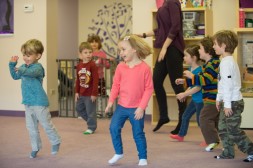
Play is one of the most important ways that two & three-year-olds learn & develop.  Emerging during childhood, imitative play is a type of play where a child begins to copy or mimic another person.  A child seeing another child play egg shakers, to match the feel of the music, or a child noticing that Mommy dances slower, when the music is slower, then matching her tempo, are examples of imitative play in action.  Imitation helps children begin to work out the relationships between themselves and the things & people around them.  From this, cooperative and pretend play will blossom during the preschool years.  Giving children plenty of opportunities to mimic a wide array of experiences, both familiar, and new, supports their ongoing development.


In our toddler classes, we use imitation to help your child begin to "feel" the music.  Whether it's moving like a slide whistle making glissandos or feeling the syncopation to a favorite chant like "On the Ground," your child will follow your lead. As you move and groove to the steady beat and enjoy the rhythmic patterns of the music, your child will begin to copy you and do the same!


How?

Go on a Listening Walk!  

As you listen to music at home this week, dance around the house, with your child.  Play a 'follow me' game, where your child imitates you sometimes, and you imitate her sometimes.  Who else wants to join the game? 

Then, play 'follow me' with some animals, during  I Can Do That, Too

Sing "Eency Weency Spider" using hand motions and invite your child to copy you. How soon were they doing the motions? Singing some of the words? 


Want to Learn More?

On our blog - read how your child's attempts to imitate you, as you sing, can nurture their speaking and singing voice!


Kindermusik 7-year continuum:

As a baby, your child relied on you to help them experience the world by doing things FOR them.  Now, as a toddler, your child learns best by imitating what you (and others) are doing.  As a preschooler, he will learn musical concepts in class by immersing himself in an imaginary world where musical things just happen (like a Make Believe pirate ship or castle, or a pretend garden full of musical animals). Big kids in Young Child classes use that imagination to create songs that match certain words or moods, and take learning a step further, by learning to read and write musical notation!

 

Preschoolers Move at Their Own TEMPO

Parenting Tip: Go fast & slow with your preschooler!


Why?

Fostering self-expression and inclusion (as we do, when giving all a turn to choose 'fast' or 'slow' tempi, as we sing in our preschool classes called "Laugh & learn") assures fairness for children, and enhances meaningful participation in their own learning. 

When children are free to express their intentions and act creatively within a form of learning, their development of basic motivation or will is strengthened.  Where this willfulness can be strengthened, a positive relationship to self-directed learning can emerge. 

This leads to the development of expertise (much like the professional musician who, through countless hours of disciplined rehearsal, becomes a expert player).  - adapted from Rhiannon Venables, Fostering Artistic and Creative Expression in Children, Learning Links - Helping Kids Learn


How?

look at 'I Can Do That!' As your child enjoys moving like each animal, encourage her to notice whether the animal moves fast or slow - then match that tempo!

Then, listen to some Garden Sounds.  If you like, extend this into a family game of 'Who's Making All That Noise' from our new home CD. 

Play the Creatures of the Garden track (from Kindermusik's In My Garden CD), and enjoy moving together like snails, mice, turtles, and rabbits.


Want to Learn More?

On our blog - See how  tempo can help you at home, and help your child in future musical endeavors!


Kindermusik 7-year continuum:

As a Kindermusik baby, your child experienced fast & slow tempo when you moved her fast or slow to the music.  In toddler classes, he discovered ways to move his own body fast or slow.  Now, in preschool Kindermusik class, your child gets to make creative decisions for the group, choosing either fast or slow tempi for our class songs (is the woodpecker pecking fast or slow today?).  In Young Child classes, big kids use these years of experience to decide how fast or slow they need to play in order to stay with the group, as well as to make creative decisions about how fast that thunderclap sound should go, when creating their own musical compositions.


Thursday, April 21, 2016

The Long & Short of Moving with Baby

Parenting Tip: Move with baby to long and short sounds, this week!


Why?

Learning to control energy is an important skill that helps with balance, expressive movement and coordination. 

When we use smooth movements to go with connected, legato sounds, and bumpy movements to go with short, staccato sounds, we are preparing your child to better-understand those musical articulations.


How?

Turn on some music and dance with baby

Then, listen to some Bird Voices!  Most of these calls have a bumpy quality to them.  Can you and baby wiggle as the birds make their calls?  What if you paused the video between birds, and rock & sway smoothly, like the clouds that float in the sky?  Does baby prefer one movement more than the other? 

Cue up 'This Little Light of Mine' (from Kindermusik's Way Up High CD), and grab a baby bell or shaker.  Can you make smooth, long, connected sounds during the intro & other choral parts?  Can you make bumpy, short, non-sustained sounds during the banjo/dancy parts?  What if you add movement to match?  What is baby's reaction?


Want to Learn More?

On our blog - read 10 Reasons Why Music Belongs in Every Child's Home (whether you are having a smooth day, or a bumpy one!).


Kindermusik's 7-Year Continuum:

Now, you are your babies guide to the opposite concepts of sustained & unsustained movement.  As the music changes from smooth to bouncy, you move baby and change movement styles accordingly.  As a toddler, you will move in smooth & bouncy ways, as your child follows along, imitating those movement styles, and noticing how they match changes in the music.  In Kindermusik preschool class, your child will learn musical terms for smooth (legato) and bouncy (staccato), and will use legato & staccato motions during musical games ('out here on the sea, the waves are bumpy today – get in your 'staccato' boats!).  As a big kid in Young Child class, your child will review staccato & legato, will draw representations of legato & staccato sounds, and will sing & perform using staccato & legato articulations.


Toddlers Can Create Musical Expression Through Dynamics

Parenting Tip: Play with loud and quiet sounds, this week!


Why?

For 2 & 3-year-olds, learning through opposites is a very effective way to present new concepts.  The opposite concepts of loud & quiet (musical 'dynamics') can be effectively experienced through playing instruments, singing, and listening. 

Movement can be incorporated into the experience as the children vary their motions, making them large and small, or heavy and light to express loud and quiet with their bodies. 

It's also important for children to begin to experience loud and quiet as an aspect of musicality.  It's natural for children to delight in playing loudly, but it requires much more emotional and physical control for young children to create music quietly.


How?

Get out an instrument or sound maker, and explore ways to play it loud and quiet. 

Turn on a favorite song from Kindermusik's Up in the Sky CD, and play the beat!  Does your child prefer loud or quiet sounds with the instrument?

Play a dynamics game!  At home, or out & about, play a game using loud and quiet voices.  (Look – a bird!  Is he loud or quiet?  Can you make quiet bird sounds?...) 


Want to Learn More?

On our blog - for ideas using loud and quiet music, read 10 Secret Musical Tricks Every Parent Should Know!


Kindermusik's 7-Year Continuum:

As a baby, your child watched and listened as you made loud and quiet sounds in class.  Now, as a toddler, she is exploring ways to make loud & quiet sounds, herself (following your lead).  As a preschooler, your child will learn musical terms for loud (forte) and quiet (piano), and will make decisions on his own about which sounds should be loud, and which should be quiet (should the lion be represented by a loud sound, or quiet?).  As a big kid in Young Child classes, your child will use piano and forte in the playing of songs on instruments (when the mouse is sneaking, play 'piano,' and when he runs away, play 'forte!').  In addition, they will learn other dynamics terms, like 'crescendo' (going from quiet to loud), and 'decrescendo' (going from loud to quiet).


Sequences & Patterns for Preschoolers

Parenting Tip: Discover sequencing through musical form – like the Pirate Treasure Dance!


Why?

Pattern awareness is crucial to learning and memory.  Just as in reading stories, singing and rhythmic speech expose participants directly to the patterns of language including rhythm, speech sounds, syntax, and rhyme.  With sequencing, we are able to put things in order form the first to the last.  Practicing this skill helps children prepare for reading comprehension & daily activities such as following a list of directions or instructions. Being able to break down a task into steps is also important in learning self-management, because appropriate sequencing helps a child reduce frustration and increase success. 


How?

Make up your own movement sequence to the Pirate Treasure Dance (on Kindermusik's Make Believe CD)!

play a royal Math Game

Then, Parrot the Pirate!  How many phrases can your child echo?  Can they remember the sequence?  What if you and your child made up your own sequence of echoes? 

Cue up the Parrot Talk song, on Kindermusik's Make Believe CD.  Play a sequencing game with pretend parrots on the beach.  (Fly like parrots during the instrumental parts, and echo the parrot whenever he speaks). 


Want to Learn More?

On our blog - read 10 Reasons Why Music Belongs in Our Schools!


Kindermusik's 7-Year Continuum:

As a baby, your child relied on you to move her body to the patterns in the music.  In toddler classes, your child watched how you moved to musical patterns, and he imitated your movements with his own body.  Now, as a preschooler, your child is discovering musical sequences on their own (the parrots fly during the instrumental part, and they stop to talk during the speaking parts – hey, it's a pattern!)  As a big kid in Young Child class, your child will discover sequences and patterns in the musical notation he is reading (look!  Both of those melody cards have C C A rest in them!)


Sunday, April 10, 2016

Babies, and Pathways in Movement

Parenting Tip: Travel in straight, zigzag, curvy, and circular pathways with baby!


Why?

Toddlers are kinesthetic learners.  They learn by moving, and doing! 

In movement activities, you're maximizing your child's spatial awareness by helping her to experience different pathways in her movement. 

By labeling the movement pathway you are taking, you are also building your child's vocabulary, and his understanding of what he is experiencing in class. 

These experiences, which connect vocabulary and movement, will build both vocabulary and movement skills.


How?

Talk words of position, with your child! 

Then, have some fun with a hulahoop :) 

Get out a throw blanket (or a bed-sheet) and take your child around the house on a blanket ride!  Will you take a straight, or curvy path?  Turn on the Waddaly Atcha song (from Kindermusik's Way Up High  CD), and ride away! 


Want to Learn More?

On our blog - did you know that movement activates the brain?


Kindermusik 7-Year Continuum:

As a baby, your child counts on you to move her body in a variety of ways – so that she knows what is possible.  In Kindermusik toddler classes, your child will use his vocabulary of movement experiences to move his own body to the music – movement is how toddlers learn best!  As a preschooler, your child will begin to use movement to express stories and music, using her own imagination.  In Young Child classes, your big kid makes use of the coordination & muscle control he's been developing over the years, as he holds glockenspiel mallets, and plays notes on his glockenspiel using just the right amount of force.  Small, quiet movements now become a lighter touch with the mallets, as big, loud movements become a heavier touch, producing more instrumental sound.


Babies, and Pathways in Movement

SP (pathways in movement + syncopation)

Parenting Tip: Travel in straight, zigzag, curvy, and circular pathways with baby!


Why?

Toddlers are kinesthetic learners.  They learn by moving, and doing! 

In movement activities, you're maximizing your child's spatial awareness by helping her to experience different pathways in her movement. 

By labeling the movement pathway you are taking, you are also building your child's vocabulary, and his understanding of what he is experiencing in class. 

These experiences, which connect vocabulary and movement, will build both vocabulary and movement skills.


How?

Talk words of position, with your child! 

Then, have some fun with a hulahoop :) 

Get out a throw blanket (or a bed-sheet) and take your child around the house on a blanket ride!  Will you take a straight, or curvy path?  Turn on the Waddaly Atcha song (from Kindermusik's Way Up High  CD), and ride away! 


Want to Learn More?

On our blog - did you know that movement activates the brain?


Kindermusik 7-Year Continuum:

As a baby, your child counts on you to move her body in a variety of ways – so that she knows what is possible.  In Kindermusik toddler classes, your child will use his vocabulary of movement experiences to move his own body to the music – movement is how toddlers learn best!  As a preschooler, your child will begin to use movement to express stories and music, using her own imagination.  In Young Child classes, your big kid makes use of the coordination & muscle control he's been developing over the years, as he holds glockenspiel mallets, and plays notes on his glockenspiel using just the right amount of force.  Small, quiet movements now become a lighter touch with the mallets, as big, loud movements become a heavier touch, producing more instrumental sound.